PCEP-30-02 Valid Vce Dumps, Valid PCEP-30-02 Exam Sims
Wiki Article
BONUS!!! Download part of ITExamDownload PCEP-30-02 dumps for free: https://drive.google.com/open?id=1UbofSQig8kbrHmJLCpyVz8EspP_NBC8B
If you study with our PCEP-30-02 exam questions, then you are better than others, and of course you will get more opportunities. You will never be picked by others. You will become the target of business competition! This will be a happy event! You must understand what it means in this social opportunity. You can get your favorite project and get a higher salary! Our PCEP-30-02 simulating exam can give you more than just the success of an exam, but also the various benefits that come along with successful PCEP-30-02 exams.
Python Institute PCEP-30-02 Exam copyright Topics:
| Topic | Details |
|---|---|
| Topic 1 |
|
| Topic 2 |
|
| Topic 3 |
|
| Topic 4 |
|
| Topic 5 |
|
>> PCEP-30-02 Valid Vce Dumps <<
Valid Python Institute PCEP-30-02 Exam Sims & Test PCEP-30-02 Objectives Pdf
PCEP-30-02 exam dumps are famous for high-quality, since we have a professional team to collect and research the first-hand information. We have reliable channel to ensure you that PCEP-30-02 exam copyright you receive is the latest information of the exam. We are strict with the quality and answers of PCEP-30-02 Exam Materials, we can guarantee you that what you receive are the best and most effective. In addition, online and offline chat service stuff are available, and if you have any questions for PCEP-30-02 exam dumps, you can consult us.
Python Institute PCEP - Certified Entry-Level Python Programmer Sample Questions (Q36-Q41):
NEW QUESTION # 36
What is true about tuples? (Select two answers.)
- A. Tuples are immutable, which means that their contents cannot be changed during their lifetime.
- B. Tuples can be indexed and sliced like lists.
- C. An empty tuple is written as { } .
- D. The len { } function cannot be applied to tuples.
Answer: A,B
Explanation:
Tuples are one of the built-in data types in Python that are used to store collections of data. Tuples have some characteristics that distinguish them from other data types, such as lists, sets, and dictionaries. Some of these characteristics are:
* Tuples are immutable, which means that their contents cannot be changed during their lifetime. Once a tuple is created, it cannot be modified, added, or removed. This makes tuples more stable and reliable than mutable data types. However, this also means that tuples are less flexible and dynamic than mutable data types. For example, if you want to change an element in a tuple, you have to create a new tuple with the modified element and assign it to the same variable12
* Tuples are ordered, which means that the items in a tuple have a defined order and can be accessed by using their index. The index of a tuple starts from 0 for the first item and goes up to the length of the tuple minus one for the last item. The index can also be negative, in which case it counts from the end of the tuple. For example, if you have a tuple t = ("a", "b", "c"), then t[0] returns "a", and t
[-1] returns "c"12
* Tuples can be indexed and sliced like lists, which means that you can get a single item or a sublist of a tuple by using square brackets and specifying the start and end index. For example, if you have a tuple t
= ("a", "b", "c", "d", "e"), then t[2] returns "c", and t[1:4] returns ("b", "c", "d"). Slicing does not raise any exception, even if the start or end index is out of range. It will just return an empty tuple or the closest possible sublist12
* Tuples can contain any data type, such as strings, numbers, booleans, lists, sets, dictionaries, or even other tuples. Tuples can also have duplicate values, which means that the same item can appear more than once in a tuple. For example, you can have a tuple t = (1, 2, 3, 1, 2), which contains two 1s and two
2s12
* Tuples are written with round brackets, which means that you have to enclose the items in a tuple with parentheses. For example, you can create a tuple t = ("a", "b", "c") by using round brackets. However, you can also create a tuple without using round brackets, by just separating the items with commas. For example, you can create the same tuple t = "a", "b", "c" by using commas. This is called tuple packing, and it allows you to assign multiple values to a single variable12
* The len() function can be applied to tuples, which means that you can get the number of items in a tuple by using the len() function. For example, if you have a tuple t = ("a", "b", "c"), then len(t) returns 312
* An empty tuple is written as (), which means that you have to use an empty pair of parentheses to create a tuple with no items. For example, you can create an empty tuple t = () by using empty parentheses.
However, if you want to create a tuple with only one item, you have to add a comma after the item, otherwise Python will not recognize it as a tuple. For example, you can create a tuple with one item t = ("a",) by using a comma12 Therefore, the correct answers are A. Tuples are immutable, which means that their contents cannot be changed during their lifetime. and D. Tuples can be indexed and sliced like lists.
Reference: Python Tuples - W3SchoolsTuples in Python - GeeksforGeeks
NEW QUESTION # 37
Insert the code boxes in the correct positions in order to build a line of code which asks the user for a float value and assigns it to the mass variable.
(Note: some code boxes will not be used.)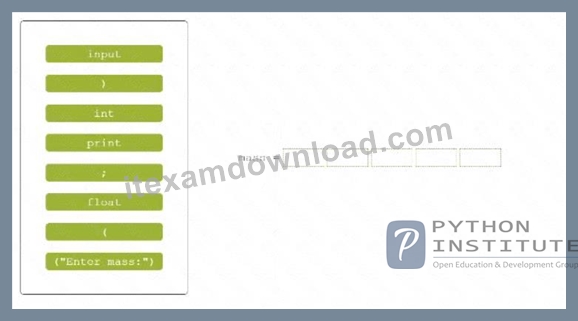
Answer:
Explanation: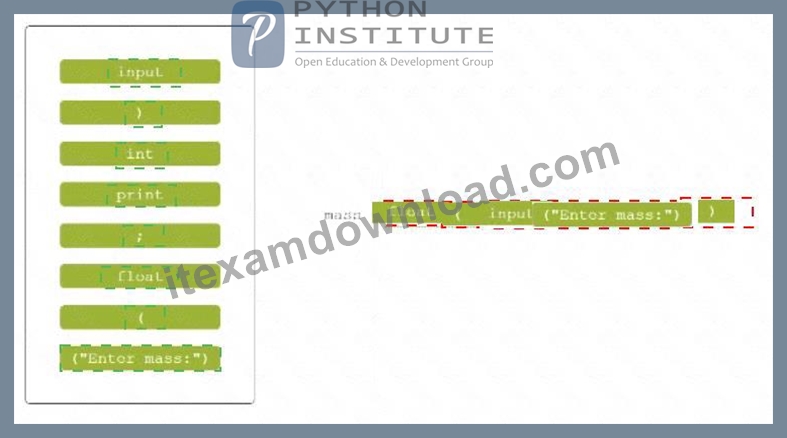
Explanation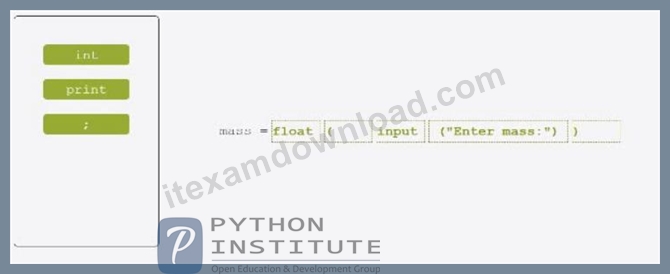
One possible way to insert the code boxes in the correct positions in order to build a line of code that asks the user for a float value and assigns it to the mass variable is:
mass = float(input("Enter the mass:
This line of code uses the input function to prompt the user for a string value, and then uses the float function to convert that string value into a floating-point number. The result is then assigned to the variable mass.
You can find more information about the input and float functions in Python in the following references:
[Python input() Function]
[Python float() Function]
NEW QUESTION # 38
What is the expected result of the following code?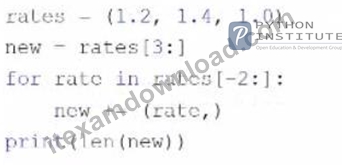
- A. The code will cause an unhandled
- B. 0
- C. 1
- D. 2
Answer: A
Explanation:
Explanation
The code snippet that you have sent is trying to use a list comprehension to create a new list from an existing list. The code is as follows:
my_list = [1, 2, 3, 4, 5] new_list = [x for x in my_list if x > 5]
The code starts with creating a list called "my_list" that contains the numbers 1, 2, 3, 4, and 5. Then, it tries to create a new list called "new_list" by using a list comprehension. A list comprehension is a concise way of creating a new list from an existing list by applying some expression or condition to each element. The syntax of a list comprehension is:
new_list = [expression for element in old_list if condition]
The expression is the value that will be added to the new list, which can be the same as the element or a modified version of it. The element is the variable that takes each value from the old list. The condition is an optional filter that determines which elements will be included in the new list. For example, the following list comprehension creates a new list that contains the squares of the even numbers from the old list:
old_list = [1, 2, 3, 4, 5, 6] new_list = [x ** 2 for x in old_list if x % 2 == 0] new_list = [4, 16, 36]The code that you have sent is trying to create a new list that contains the elements from the old list that are greater than 5. However, there is a problem with this code. The problem is that none of the elements in the old list are greater than 5, so the condition is always false. This means that the new list will be empty, and the expression will never be evaluated. However, the expression is not valid, because it uses the variable x without defining it. This will cause a NameError exception, which is an error that occurs when a variable name is not found in the current scope. The code does not handle the exception, and therefore it will terminate with an error message.
The expected result of the code is an unhandled exception, because the code tries to use an undefined variable in an expression that is never executed. Therefore, the correct answer is D. The code will cause an unhandled exception.
NEW QUESTION # 39
Assuming that the following assignment has been successfully executed:
Which of the following expressions evaluate to True? (Select two expressions.)
- A. the_list. index {'1'} -- 0
- B. the_List.index {"1"} in the_list
- C. 1.1 in the_list |1:3 |
- D. len (the list [0:2]} <3
Answer: A,D
Explanation:
The code snippet that you have sent is assigning a list of four values to a variable called "the_list". The code is as follows:
the_list = ['1', 1, 1, 1]
The code creates a list object that contains the values '1', 1, 1, and 1, and assigns it to the variable "the_list".
The list can be accessed by using the variable name or by using the index of the values. The index starts from
0 for the first value and goes up to the length of the list minus one for the last value. The index can also be negative, in which case it counts from the end of the list. For example, the_list[0] returns '1', and the_list[-1] returns 1.
The expressions that you have given are trying to evaluate some conditions on the list and return a boolean value, either True or False. Some of them are valid, and some of them are invalid and will raise an exception.
An exception is an error that occurs when the code cannot be executed properly. The expressions are as follows:
A). the_List.index {"1"} in the_list: This expression is trying to check if the index of the value '1' in the list is also a value in the list. However, this expression is invalid, because it uses curly brackets instead of parentheses to call the index method. The index method is used to return the first occurrence of a value in a list. For example, the_list.index('1') returns 0, because '1' is the first value in the list. However, the_list.index
{"1"} will raise a SyntaxError exception and output nothing.
B). 1.1 in the_list |1:3 |: This expression is trying to check if the value 1.1 is present in a sublist of the list.
However, this expression is invalid, because it uses a vertical bar instead of a colon to specify the start and end index of the sublist. The sublist is obtained by using the slicing operation, which uses square brackets and a colon to get a part of the list. For example, the_list[1:3] returns [1, 1], which is the sublist of the list from the index 1 to the index 3, excluding the end index. However, the_list |1:3 | will raise a SyntaxError exception and output nothing.
C). len (the list [0:2]} <3: This expression is trying to check if the length of a sublist of the list is less than 3.
This expression is valid, because it uses the len function and the slicing operation correctly. The len function is used to return the number of values in a list or a sublist. For example, len(the_list) returns 4, because the list has four values. The slicing operation is used to get a part of the list by using square brackets and a colon. For example, the_list[0:2] returns ['1', 1], which is the sublist of the list from the index 0 to the index 2, excluding the end index. The expression len (the list [0:2]} <3 returns True, because the length of the sublist ['1', 1] is 2, which is less than 3.
D). the_list. index {'1'} - 0: This expression is trying to check if the index of the value '1' in the list is equal to 0. This expression is valid, because it uses the index method and the equality operator correctly. The index method is used to return the first occurrence of a value in a list. For example, the_list.index('1') returns 0, because '1' is the first value in the list. The equality operator is used to compare two values and return True if they are equal, or False if they are not. For example, 0 == 0 returns True, and 0 == 1 returns False. The expression the_list. index {'1'} - 0 returns True, because the index of '1' in the list is 0, and 0 is equal to 0.
Therefore, the correct answers are C. len (the list [0:2]} <3 and D. the_list. index {'1'} - 0.
Reference: Python List Methods - W3Schools5. Data Structures - Python 3.11.5 documentationList methods in Python - GeeksforGeeks
NEW QUESTION # 40
Which of the following sentences are true? (Select two answers.)
- A. It's possible to define more than one function of the same name.
- B. Function is obliged to return a value.
- C. A function can invoke itself.
- D. Every function must be defined before it is invoked.
Answer: C,D
NEW QUESTION # 41
......
Earning the PCEP - Certified Entry-Level Python Programmer (PCEP-30-02) exam credential is undoubtedly a big achievement. No matter how hard the PCEP - Certified Entry-Level Python Programmer (PCEP-30-02) test of this certification is, it serves the important purpose to validate skills in the Python Institute industry. Once you crack the PCEP - Certified Entry-Level Python Programmer (PCEP-30-02) exam, a whole new career scope opens up for you. Candidates for the PCEP - Certified Entry-Level Python Programmer (PCEP-30-02) exam dumps usually don't have enough time to study for the test. To prepare successfully in a short time, you need a trusted platform of real and updated PCEP - Certified Entry-Level Python Programmer (PCEP-30-02) exam dumps.
Valid PCEP-30-02 Exam Sims: https://www.itexamdownload.com/PCEP-30-02-valid-questions.html
- Renowned PCEP-30-02 Learning Quiz display the most useful Exam Brain Dumps - www.practicevce.com ???? Copy URL ➠ www.practicevce.com ???? open and search for ➤ PCEP-30-02 ⮘ to download for free ????PCEP-30-02 Latest Exam Registration
- PCEP-30-02 Test Collection Pdf ???? PCEP-30-02 Test Pdf ???? PCEP-30-02 Latest Exam Pdf ???? Easily obtain free download of ▶ PCEP-30-02 ◀ by searching on ⮆ www.pdfvce.com ⮄ ????PCEP-30-02 High Quality
- Latest PCEP-30-02 Test Sample ???? Verified PCEP-30-02 Answers ???? Valid PCEP-30-02 Test Pass4sure ???? Download ➠ PCEP-30-02 ???? for free by simply searching on 「 www.testkingpass.com 」 ????PCEP-30-02 Test Collection Pdf
- 2026 Latest PCEP-30-02 Valid Vce Dumps | 100% Free Valid PCEP - Certified Entry-Level Python Programmer Exam Sims ???? Search for ⮆ PCEP-30-02 ⮄ and download it for free on ( www.pdfvce.com ) website ????Latest PCEP-30-02 Test Sample
- Providing You 100% Pass-Rate PCEP-30-02 Valid Vce Dumps with 100% Passing Guarantee ???? Search for ▛ PCEP-30-02 ▟ on [ www.prepawayete.com ] immediately to obtain a free download ????Latest PCEP-30-02 Test Sample
- 2026 Pass-Sure Python Institute PCEP-30-02: PCEP - Certified Entry-Level Python Programmer Valid Vce Dumps ???? Open website ➽ www.pdfvce.com ???? and search for 「 PCEP-30-02 」 for free download ????PCEP-30-02 Test Questions Vce
- 2026 Latest PCEP-30-02 Valid Vce Dumps | 100% Free Valid PCEP - Certified Entry-Level Python Programmer Exam Sims ???? The page for free download of ▷ PCEP-30-02 ◁ on ➡ www.practicevce.com ️⬅️ will open immediately ????New PCEP-30-02 Exam Pattern
- Reliable PCEP-30-02 Valid Vce Dumps Supply you Verified Valid Exam Sims for PCEP-30-02: PCEP - Certified Entry-Level Python Programmer to Prepare easily ???? The page for free download of ⮆ PCEP-30-02 ⮄ on 【 www.pdfvce.com 】 will open immediately ????Training PCEP-30-02 Kit
- PCEP-30-02 test questions: PCEP - Certified Entry-Level Python Programmer - PCEP-30-02 pass-king dumps ???? Enter ( www.exam4labs.com ) and search for ➠ PCEP-30-02 ???? to download for free ????Valid PCEP-30-02 Exam Tutorial
- PCEP-30-02 Test Pdf ???? PCEP-30-02 Test Collection Pdf ???? PCEP-30-02 Exam Online ???? Easily obtain 【 PCEP-30-02 】 for free download through ➠ www.pdfvce.com ???? ????PCEP-30-02 Original Questions
- Providing You 100% Pass-Rate PCEP-30-02 Valid Vce Dumps with 100% Passing Guarantee ???? Download ✔ PCEP-30-02 ️✔️ for free by simply searching on ✔ www.examdiscuss.com ️✔️ ????PCEP-30-02 Latest Exam Registration
- wodirectory.com, rishikgnj238322.get-blogging.com, rajanpgjo976802.blogsumer.com, mattieouma336614.blogaritma.com, tamzincyyg338217.myparisblog.com, nelsonjghu780121.bloggerchest.com, haimafzjt219846.estate-blog.com, minazdnh274206.wikienlightenment.com, studyzonebd.com, brendaqxdl087190.wikilentillas.com, Disposable vapes
2026 Latest ITExamDownload PCEP-30-02 copyright and PCEP-30-02 copyright Free Share: https://drive.google.com/open?id=1UbofSQig8kbrHmJLCpyVz8EspP_NBC8B
Report this wiki page